

Modular Deep Reinforcement Learning framework in PyTorch.
Companion library of the book Foundations of Deep Reinforcement Learning.
Documentation · Benchmark Results
NOTE: v5.0 updates to Gymnasium,
uvtooling, and modern dependencies with ARM support - see CHANGELOG.md.Book readers:
git checkout v4.1.1for Foundations of Deep Reinforcement Learning code.
 |
 |
 |
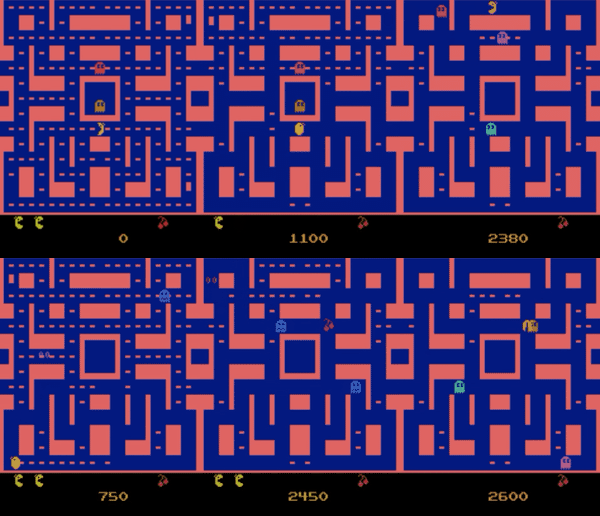 |
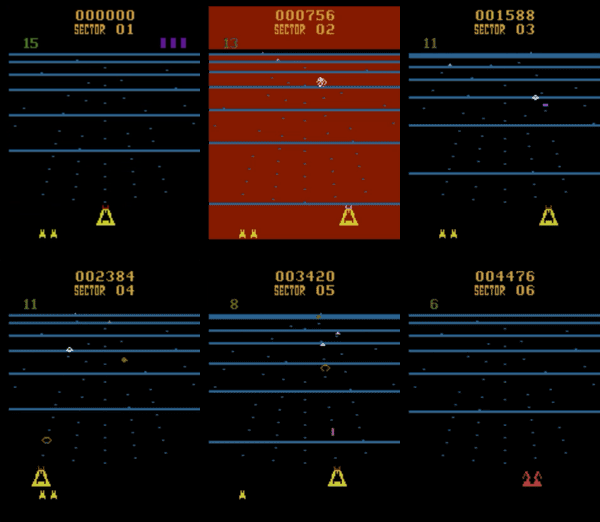
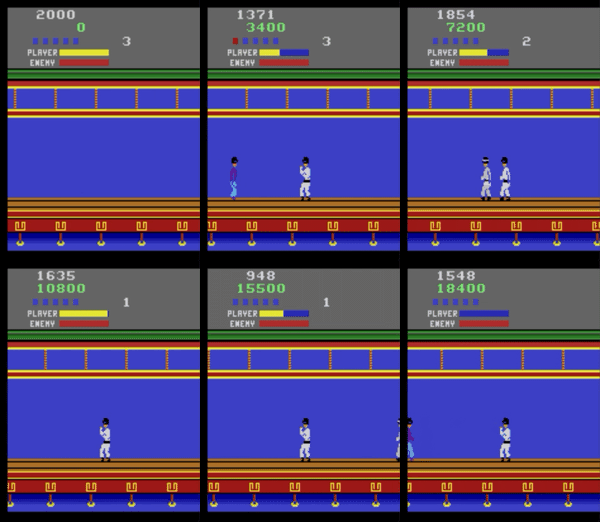
| BeamRider | Breakout | KungFuMaster | MsPacman |
 |
 |
 |
 |
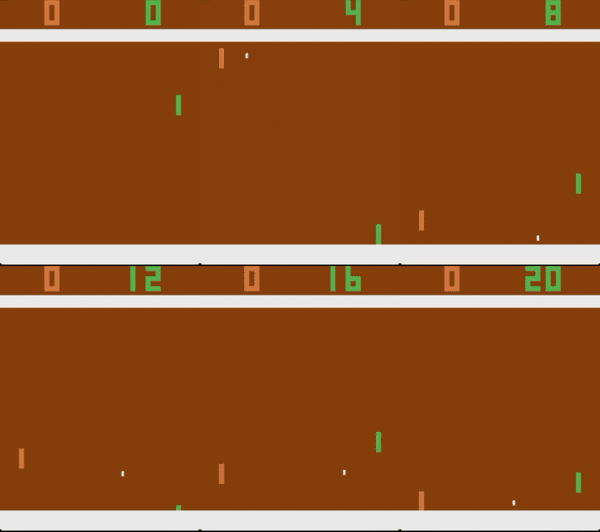
| Pong | Qbert | Seaquest | Sp.Invaders |
 |
 |
 |
 |
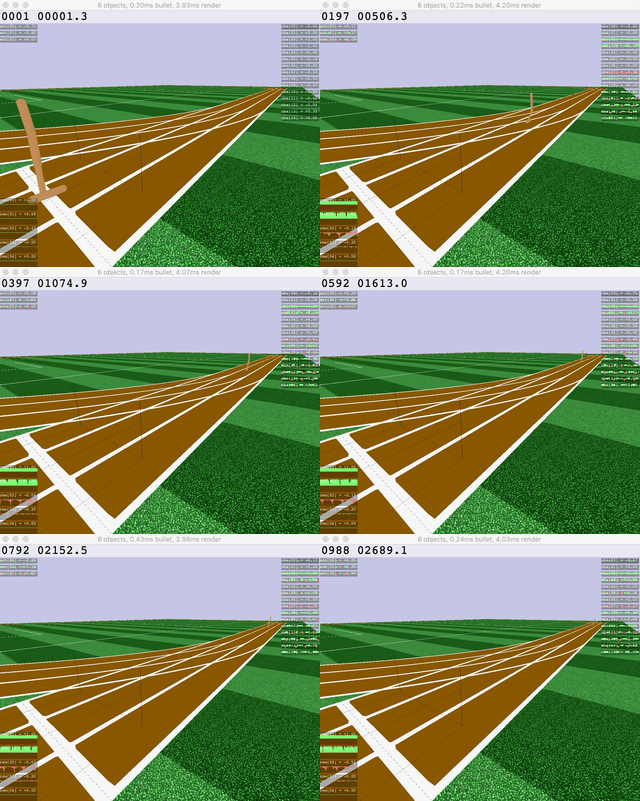
| Ant | HalfCheetah | Hopper | Humanoid |
 |
 |
 |
 |
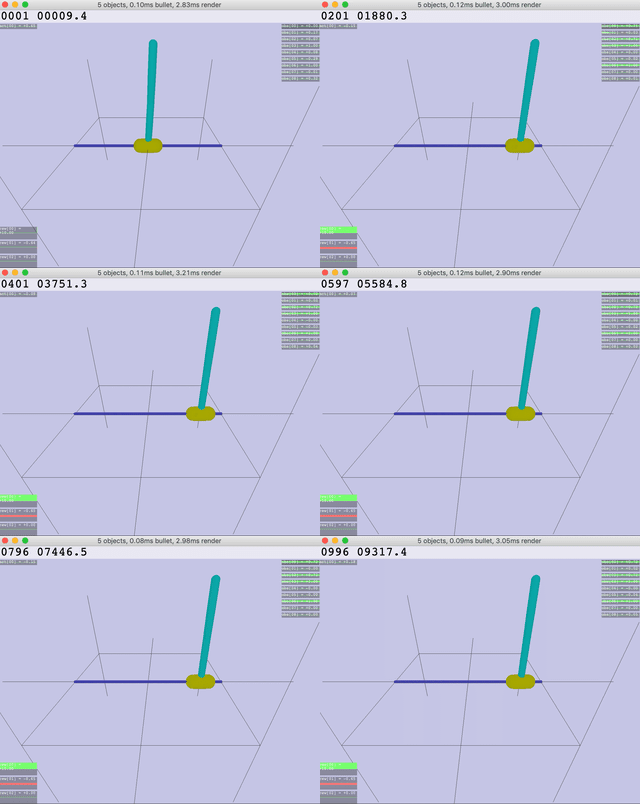
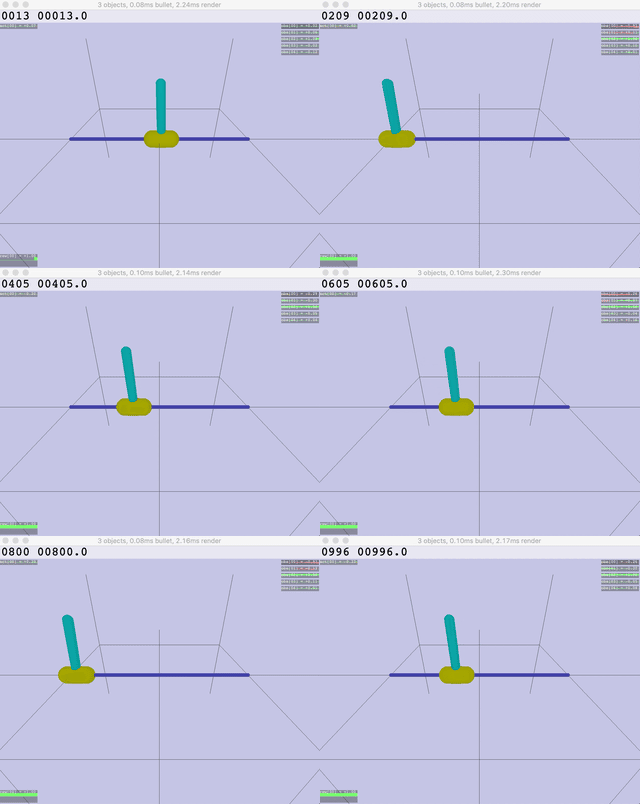
| Inv.DoublePendulum | InvertedPendulum | Reacher | Walker |
SLM Lab is a software framework for reinforcement learning (RL) research and application in PyTorch. RL trains agents to make decisions by learning from trial and error—like teaching a robot to walk or an AI to play games.
| Feature | Description |
|---|---|
| Ready-to-use algorithms | PPO, SAC, DQN, A2C, REINFORCE—validated on 70+ environments |
| Easy configuration | JSON spec files fully define experiments—no code changes needed |
| Reproducibility | Every run saves its spec + git SHA for exact reproduction |
| Automatic analysis | Training curves, metrics, and TensorBoard logging out of the box |
| Cloud integration | dstack for GPU training, HuggingFace for sharing results |
| Algorithm | Type | Best For | Validated Environments |
|---|---|---|---|
| REINFORCE | On-policy | Learning/teaching | Classic |
| SARSA | On-policy | Tabular-like | Classic |
| DQN/DDQN+PER | Off-policy | Discrete actions | Classic, Box2D, Atari |
| A2C | On-policy | Fast iteration | Classic, Box2D, Atari |
| PPO | On-policy | General purpose | Classic, Box2D, MuJoCo (11), Atari (54) |
| SAC | Off-policy | Continuous control | Classic, Box2D, MuJoCo |
See Benchmark Results for detailed performance data.
SLM Lab uses Gymnasium (the maintained fork of OpenAI Gym):
| Category | Examples | Difficulty | Docs |
|---|---|---|---|
| Classic Control | CartPole, Pendulum, Acrobot | Easy | Gymnasium Classic |
| Box2D | LunarLander, BipedalWalker | Medium | Gymnasium Box2D |
| MuJoCo | Hopper, HalfCheetah, Humanoid | Hard | Gymnasium MuJoCo |
| Atari | Breakout, MsPacman, and 54 more | Varied | ALE |
Any gymnasium-compatible environment works—just specify its name in the spec.
# Install
uv sync
uv tool install --editable .

# Run demo (PPO CartPole)
slm-lab run                                    # PPO CartPole
slm-lab run --render                           # with visualization

# Run custom experiment
slm-lab run spec.json spec_name train          # local training
slm-lab run-remote spec.json spec_name train   # cloud training (dstack)

# Help (CLI uses Typer)
slm-lab --help                                 # list all commands
slm-lab run --help                             # options for run command

# Troubleshoot: if slm-lab not found, use uv run
uv run slm-lab runRun experiments on cloud GPUs with automatic result sync to HuggingFace.
# Setup
cp .env.example .env  # Add HF_TOKEN
uv tool install dstack  # Install dstack CLI
# Configure dstack server - see https://dstack.ai/docs/quickstart

# Run on cloud
slm-lab run-remote spec.json spec_name train           # CPU training (default)
slm-lab run-remote spec.json spec_name search          # CPU ASHA search (default)
slm-lab run-remote --gpu spec.json spec_name train     # GPU training (for image envs)

# Sync results
slm-lab pull spec_name    # Download from HuggingFace
slm-lab list              # List available experiments
Config options in .dstack/: run-gpu-train.yml, run-gpu-search.yml, run-cpu-train.yml, run-cpu-search.yml
For a lightweight box that only dispatches dstack runs, syncs results, and generates plots (no local ML training):
uv sync --no-default-groups
uv run --no-default-groups slm-lab run-remote spec.json spec_name train
uv run --no-default-groups slm-lab pull spec_name
uv run --no-default-groups slm-lab plot -f folder1,folder2If you use SLM Lab in your research, please cite:
@misc{kenggraesser2017slmlab,
    author = {Keng, Wah Loon and Graesser, Laura},
    title = {SLM Lab},
    year = {2017},
    publisher = {GitHub},
    journal = {GitHub repository},
    howpublished = {\url{https://github.com/kengz/SLM-Lab}},
}MIT